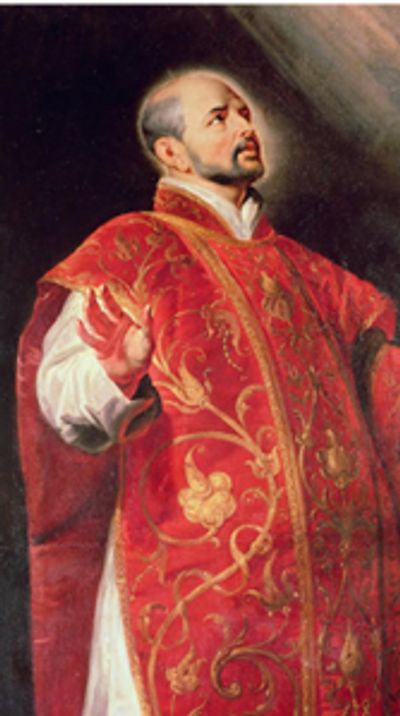
St. Ignatius of Loyola
An excerpt by Rev. Norman B. O’Neal
St. Ignatius was born in 1491 in northern Spain. He was the youngest of 13 children. At age 16 he was sent to serve as a page to Juan Velazquez, the treasurer of the kingdom of Castile. As a member of the Velazquez household, he was frequently at court and developed a taste for all it represented, especially the ladies. He was much addicted to gambling, very contentious, and not above engaging in sword play on occasion. In fact, once he had to flee the town.
In 1521, at age 30, Ignatius was an officer defending the fortress of the town of Pamplona against the French. The Spaniards were terribly outnumbered, and the commander of the Spanish forces wanted to surrender but Ignatius convinced him to fight on for the honor of Spain, if not for victory. During the battle, a cannon ball struck Ignatius, wounding one leg and breaking the other. Because they admired his courage, the French soldiers carried him back to recuperate at his home, the castle of Loyola, rather than taking him to prison.
His leg was set but did not heal. It was necessary to break it again and reset it (this without anesthesia). Ignatius grew worse and was expected to die, but he had an unexpected turn for the better, and his leg healed. However, a bone protruded below the knee and one leg was shorter than the other. This was unacceptable to Ignatius, who considered it a fate worse than death not to be able to wear the long, tight fitting boots and hose of the courtier. Therefore, he ordered the doctors to saw off the offending knob of bone and lengthen the leg by systematic stretching (again, without anesthesia). This was not a successful procedure and Ignatius walked with a limp the rest of his life.
During his recuperation, he was extremely bored and asked for some romance novels to pass the time. There were none, but there was the “Life of Christ” and a book on the saints. Desperate, Ignatius began to read them. The more he read, the more he considered the exploits of the saints worth imitating. However, at the same time, he continued to have day dreams of fame and glory, along with fantasies of winning the love a certain noble lady of the court. He noticed, though, that after reading and thinking of the saints and Christ, he was at peace and satisfied. Yet when he finished his long day dreams of his noble lady, he would feel restless and unsatisfied. Not only was this experience the beginning of his conversion, it was also the beginning of spiritual discernment or discernment of spirits, which is associated with Ignatius and described in his Spiritual Exercises.
The Exercises recognize that not only the intellect but also the emotions and feelings can help us to come to a knowledge of the action of the Spirit in our lives. Eventually, completely converted from his old desires and plans of romance and worldly conquest, Ignatius had recovered from his wounds enough to travel. In March of 1522, he left the castle and proceeded to the Benedictine shrine of Our Lady of Montserrat, made a general confession, and knelt all night in vigil before Our Lady’s altar. He left his sword and knife at the altar, went out and gave away all his fine clothes to a poor man, and dressed himself in rough clothes with sandals and a staff.
He continued towards Barcelona but stopped along the river Cardoner at a town called Manresa. He stayed in a cave outside the town, intending to linger only a few days, but he remained for 10 months. He spent hours each day in prayer and also worked in a hospice. It was while here that the ideas for what is now known as the Spiritual Exercises began to take shape. It was also on the banks of this river that he had a vision which is regarded as the most significant in his life. The vision was more of an enlightenment, about which he later said that he learned more on that one occasion than he did in the rest of his life. It was never revealed by Ignatius exactly what the vision was; but it seems to have been an encounter with God as He really is so that all creation was seen in a new light and acquired a new meaning and relevance, an experience that enabled Ignatius to find God in all things.